
HVAC Testing
Heating, Ventilation, and Air Conditioning (HVAC) systems have now become an integral part of any commercial as well as residential buildings. As these systems become more complex, ensuring their safety, efficiency, and reliability before the project handover has become a crucial aspect. It also ensures that complaints from end-users for under- or over-cooling and poor indoor air quality are kept to a minimum.
Complex buildings of today require very careful integration of numerous interdependent systems. After installation, the system undergoes a rigorous checkup for various critical factors. One major component of this is the verification of the materials and equipment, their installation, and checking if they meet the client’s requirements. The second most important component is checking for proper equipment operation. The system undergoes a sequence of operations, which are then carefully documented for further analysis. The process improves indoor air quality by ensuring that all the components of the HVAC system work in complete harmony. It also sets the system up for easy maintenance and management of facilities.


HVAC Air Balancing (TAB)
HVAC Air Performance Test
Ventilation Air Balancing Test
Ventilation Air Performance Test
Noise Exposure Monitoring
Temperature Mapping
Solutions for Hospitality
Indoor Air Quality Snag Assessment
Why is Air Balancing Important?
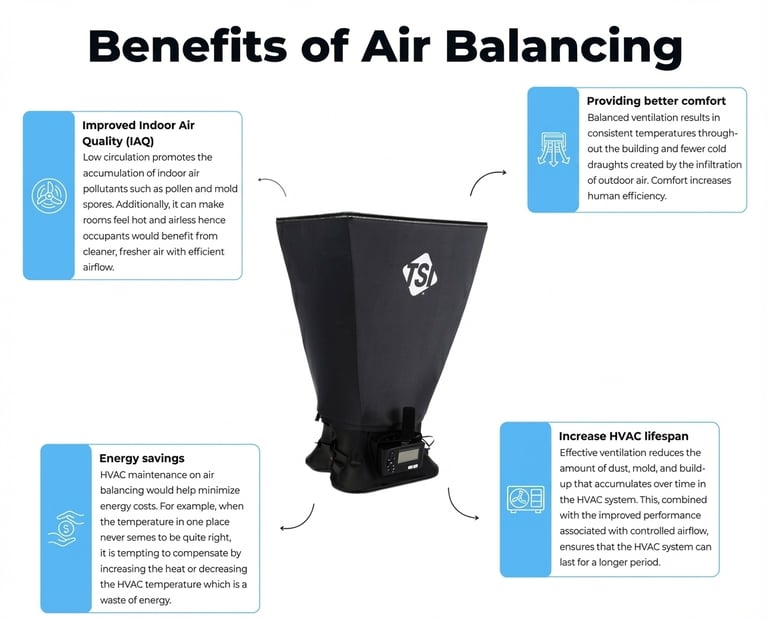
Air balancing has evolved into an essential practice for commercial projects, serving as a vital method for optimizing HVAC system performance. This process involves precise measurement and adjustment to ensure that every room receives the appropriate amount of airflow, which is critical for maintaining uniform temperature distribution throughout a building. By addressing inconsistencies where some rooms are warmer or colder than others, air balancing eliminates hot spots and drafts, ensuring maximum comfort and operational effectiveness. Large buildings, in particular, require this careful monitoring to prevent ventilation imbalances that can lead to system strain and occupant discomfort.
Beyond immediate comfort, implementing comprehensive air balancing offers long-term benefits for both indoor environments and equipment. It significantly enhances Indoor Air Quality (IAQ) by minimizing the accumulation of pollutants and mold spores, while simultaneously driving energy savings by reducing the need to overcompensate for poor airflow with extreme temperature settings. This improved efficiency not only lowers utility costs but also extends the lifespan of the HVAC system by reducing the buildup of dust and mechanical wear. For a healthy and efficient facility, trusting experts to deliver these tailored adjustments is key to achieving a sustainable and high-performing indoor environment.
CSE TECHNICAL SERVICES
Address:
Office No. 583, M-03 Floor,
Al Khabeesi Building,
Al Qusais, Dubai-UAE
CONNECT WITH us
Contact Us !
© 2025. All rights reserved.